
Trapped 30 Metres Down: Harrison Okene’s 60 Hours
Cook Harrison Okene survived 60 hours in an air pocket 30 metres under the Atlantic after his tugboat sank. This is how he lived — and how he was found.

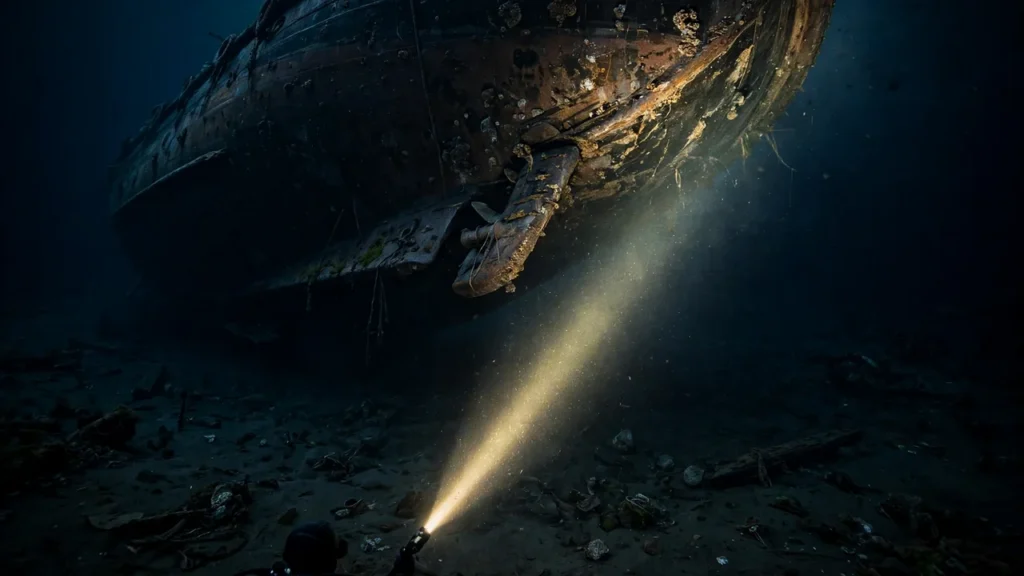
At about ten to five on the morning of 26 May 2013, Harrison Okene was in the toilet of the tugboat Jascon-4 when the sea came for him. The tug was working in heavy swells off the coast of Nigeria, steadying an oil tanker at a Chevron platform some twenty miles out, when a huge wave rolled her over. Okene, the ship’s 29-year-old cook, felt the vessel turn, heard the chaos begin — and then the world flipped upside down and filled with water.
Jump to section
The Jascon-4 sank fast. She came to rest on the seabed, upside down, roughly thirty metres — about a hundred feet — below the surface of the Atlantic. Of the twelve men aboard, eleven would never come home. But in one small room of the overturned ship, in total darkness, Harrison Okene was still breathing.
Watch the full report:
A pocket of air
Okene had been wearing only his underpants when the tug capsized. Half-drowned and in pitch blackness, he fought his way through the flooded, inverted interior and found the thing that would save his life: a small pocket of trapped air, in and around the toilet compartment and an adjoining room, about four feet high. In that upside-down world, he clung to the base of an overturned washbasin to keep his head above the water.
Everything about his situation was against him. The water was bitterly cold. The air pocket was finite — every breath he took used up oxygen and added carbon dioxide to a space that was also, slowly, shrinking as the water level crept up. He had almost nothing: no light, no dry clothes, no way to signal anyone. According to later accounts, he managed to salvage small comforts where he found them — a can of cola, some sardines — and he made a line from torn strips of his coveralls to help him feel his way to other compartments and back to his air pocket without getting lost in the dark. And he prayed. By his own account, he prayed and sang hymns through the endless night that had no morning.
Experts would later put numbers on how close he came. A diving medicine specialist at Duke University, asked about the case, estimated that in an air pocket of that size a man might have had roughly 56 hours before carbon dioxide poisoning began to take hold, and that by around 79 hours he would probably have lost consciousness. Okene did not know these numbers. He just knew the air was getting worse, the cold was in his bones, and small sea creatures — crayfish, by some accounts — were nipping at his submerged skin.
A rescue nobody expected
What Okene could not know was that far above him, the owners of the Jascon-4 and Chevron had sent a team of South African divers from the salvage firm DCN Diving out to the wreck. But this was not, in anyone’s mind, a rescue mission. By the time the divers went down, the assumption — the reasonable, terrible assumption — was that all twelve crewmen were dead. The divers were there to recover bodies.
Working through the black interior of the wreck, the divers had already found the dead. Then one of them, moving along a passageway, felt something impossible: a hand. It reached out of the darkness and took hold of his. For a split second the diver believed he was touching another corpse. Then the hand gripped back.
It is one of the most extraordinary moments ever captured on a diver’s helmet camera — footage that was later released and seen around the world. Okene, who had heard movement and hammering and had seen the faint glow of a torch pass his compartment, had swum out and found his rescuer. The operation changed in an instant from recovery to rescue. The divers calmed him, fitted him with a helmet and breathing equipment, and guided him through the wreck to a diving bell. He reached the surface at 7:32 that evening — more than sixty hours after the Jascon-4 went down.
The slow way back
Even then, Harrison Okene could not simply step back into the world. He had spent nearly three days breathing air at the pressure of thirty metres down, and a sudden return to surface pressure would have killed him — the bends, the same danger every deep diver fears. So he was sealed into a decompression chamber, where his body was brought back to normal pressure gradually; by his account, he spent around another sixty hours inside it. Only then did he learn the full truth: of the twelve men who had sailed on the Jascon-4, he was the only one alive. Divers recovered ten bodies. One of his crewmates was never found.
There is a final detail to this story that sounds invented but is not. The ordeal did not leave Okene frightened of the sea. He went back to it — he trained, and qualified, as a professional diver himself. And according to those who have told his story since, the man who handed him his diving certificate was one of the divers who had pulled him from the wreck.
Sixty hours in the dark, in the cold, in a shrinking bubble of air at the bottom of the Atlantic. Harrison Okene’s survival is sometimes described as a miracle. He has always described it more simply: he prayed, and he held on.
 Next article The Toxic Lady: Gloria Ramirez and the ER Mystery
Storyline UK is an independent entertainment publication. Film, programme and platform names belong to their respective owners; rumours are labelled as rumours.