
The Toxic Lady: Gloria Ramirez and the ER Mystery
In 1994 a dying woman was rushed into a California ER — then the staff saving her began to faint. The unsolved mystery of Gloria Ramirez, the 'Toxic Lady'.

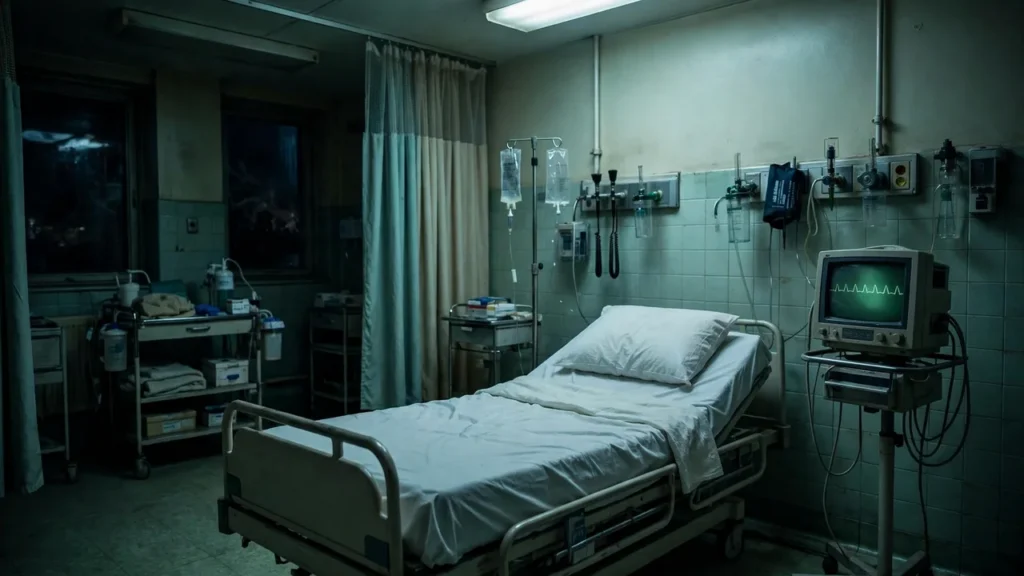
At about a quarter past eight on the evening of 19 February 1994, paramedics wheeled a dying woman into the emergency room of Riverside General Hospital in Riverside, California. Her name was Gloria Ramirez. She was 31 years old, a mother, and she was in the final stages of cervical cancer; her heart was racing out of control, her breathing was failing, and the team around her trauma bay began the standard, desperate work of trying to keep her alive.
Jump to section
Within half an hour, that team was collapsing around her. One nurse fainted, then a doctor, then a third member of staff. Twenty-three people in the emergency department fell ill. The hospital evacuated its entire emergency room into the car park. And Gloria Ramirez — who died that night — was given a name by the press that has followed her ever since: the Toxic Lady.
Watch the full report:
The night the emergency room emptied
The strangeness announced itself in details the staff noticed one by one. When Ramirez’s clothing was cut away to attach heart monitors, several of them saw that her skin was coated with an odd, oily sheen. There was a smell — fruity, and like garlic — that seemed to come from her mouth. She was sedated, and a registered nurse named Susan Kane drew blood from her arm. As the blood filled the syringe, Kane caught an ammonia-like smell coming from the tube.
Kane passed the syringe to Julie Gorchynski, a medical resident, who saw something that has never been satisfactorily explained: strange, manila-coloured crystalline particles floating in the blood. Then Kane said she could feel a burning sensation on her face — and fainted. She was carried out of the room. Minutes later, Gorchynski, by then feeling nauseous and light-headed, sat down at a nurses’ station — and fainted before she could answer a colleague who asked if she was all right. A respiratory therapist, Maureen Welch, was the third to go down.
The hospital did the only thing it could: it ordered the emergency room evacuated, moving patients into the car park while a skeleton crew in the trauma bay kept working on Ramirez. At 8:50 that evening, after 45 minutes of CPR and defibrillation, Gloria Ramirez was pronounced dead — of kidney failure caused by her cancer. But the night’s toll was counted in more than one patient. Twenty-three of the staff who had been near her became ill, with symptoms including fainting, shortness of breath, muscle spasms and burning sensations. Five were admitted to hospital. Gorchynski, the young doctor who had studied the blood, was the most seriously affected: she spent two weeks in intensive care.
Hysteria, or chemistry?
The investigation that followed was enormous and, at first, insulting to the people it concerned. County health officials brought in California’s Department of Health Services; two scientists, Ana Maria Osorio and Kirsten Waller, interviewed 34 members of staff who had been on duty that night. When no toxin could be found in the treatment room, the inquiry leaned toward an explanation that the sickened staff bitterly resented: mass hysteria. The nurses and doctors who had fainted — one of whom had spent a fortnight in intensive care — did not believe they had imagined it, and the physical pattern of the illnesses, worst in those closest to Ramirez and to her blood, argued against it.
So the Riverside County Coroner’s Office sent the problem somewhere unusual: the Forensic Science Center at Lawrence Livermore National Laboratory, better known for nuclear weapons research than for emergency medicine. And there, scientists led by a chemist named Patrick Grant built the theory that remains, to this day, the leading explanation — one so strange that it sounds like fiction, and which must be understood as a theory, because it has never been conclusively proven.
The leading theory
The Livermore team proposed that the key was something Ramirez may have been doing to cope with the pain of her final illness: using DMSO. Dimethyl sulfoxide is an industrial solvent that circulates widely as a home remedy — sold as a gel, rubbed on the skin for pain. It also, notably, produces a garlic-like taste and smell. The scientists theorised that because Ramirez’s kidneys were failing and her urinary tract was blocked, DMSO had built up in her body to unusual levels.
Then came the chain reaction they proposed. The oxygen given to her by paramedics and hospital staff, they suggested, converted the DMSO in her blood into a related compound, dimethyl sulfone — a substance known to crystallise at room temperature, which would explain the pale crystals Gorchynski saw in the syringe. And the powerful electric shocks of the defibrillator, the theory holds, may then have converted that compound into dimethyl sulfate — a genuinely dangerous chemical, once used as a war gas, whose effects include exactly the fainting, convulsions and breathing difficulties the staff reported. On this account, the gas formed in and around Ramirez’s blood and body during the resuscitation, and the people who breathed it fell.
The theory was published in the journal Forensic Science International and endorsed by the Riverside Coroner’s Office as the most likely explanation. But it has always had critics, and honesty requires naming the doubts. Some toxicologists regard the chemistry as improbable — dimethyl sulfate is not easily made, and whether a defibrillator could perform that conversion inside a blood sample is contested. Ramirez’s family rejected the theory, feeling it implied she had somehow poisoned herself, and pointed instead toward the hospital — where, it later emerged, there had been issues worth scrutinising; some have suggested other chemical exposures entirely. No investigation ever produced a vial, a measurement, a smoking gun. What happened in that room was inferred, never directly observed.
What we know, and what we don’t
Strip away the theories and the facts are stark enough. A young woman died of cancer, as everyone expected her to. On the way, something about her body — something never reproduced or fully identified — made twenty-three healthy people ill, put five in hospital and one in intensive care, and forced a hospital to treat her remains with extreme caution while the experts argued. Gloria Ramirez did not choose her nickname, and her family never wanted it. She was a patient in the worst hour of her life. But the night she died remains one of the most baffling medical events ever recorded: a mystery with a leading theory, a stack of incident reports — and no answer that has ever satisfied everyone who was in that room.
 Next article Dr Crippen: Caught by a Wireless Message
Storyline UK is an independent entertainment publication. Film, programme and platform names belong to their respective owners; rumours are labelled as rumours.