
Dr Crippen: Caught by a Wireless Message
Dr Crippen fled across the Atlantic in 1910 with his lover disguised as a boy. A captain's wireless message made him the first fugitive caught by radio.

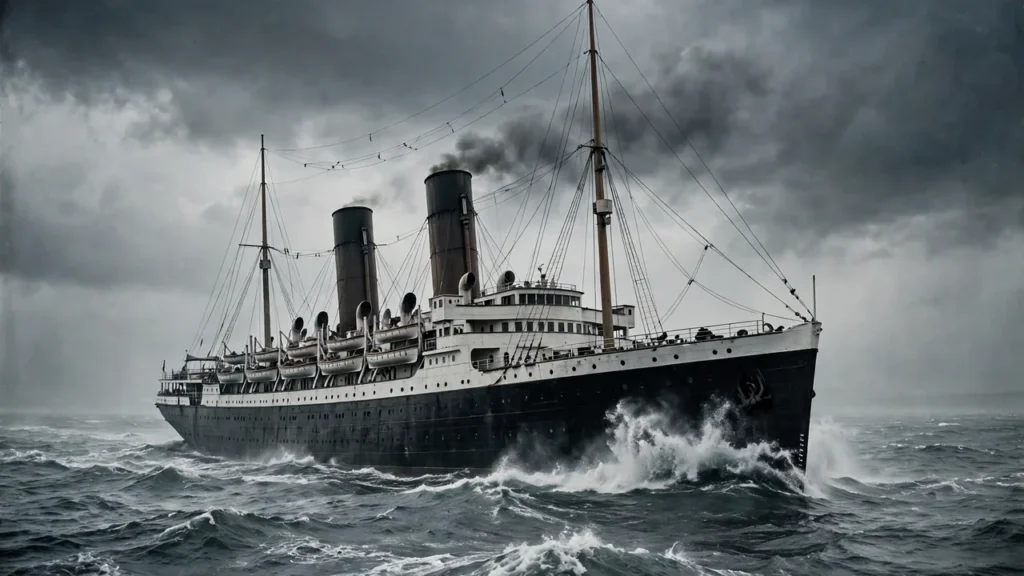
On the morning of 31 July 1910, the Canadian Pacific liner Montrose was coming up the St Lawrence River toward Quebec when a launch brought the river pilots aboard. The captain, Henry George Kendall, had invited two of his saloon passengers up to the bridge to watch — a quiet, bespectacled man travelling as Mr Robinson, and his teenage “son”. As the lead pilot stepped onto the bridge, he took off his cap, turned to the older passenger, and said, as he later told it: “Good morning, Dr Crippen. Do you know me? I’m Chief Inspector Dew from Scotland Yard.”
Jump to section
The pilot was no pilot. He was a detective who had raced across the Atlantic on a faster ship to be waiting in the river. And the arrest he made that morning — the first in history brought about by wireless telegraphy — turned a mild-mannered London medicine salesman into the most famous murderer of the Edwardian age.
Watch the full report:
The doctor who wasn’t quite
Hawley Harvey Crippen was born in Coldwater, Michigan, in 1862 and trained in homeopathic medicine in America. His qualifications did not entitle him to practise as a doctor in Britain, so in London he did the next thing down: he ran offices for American patent-medicine firms, respectable work that kept him in starched collars and quiet obscurity. His wife, Cora — born Kunigunde Mackamotski, and known on the music-hall stage as Belle Elmore — was everything he was not: loud, flamboyant, fond of company and of spending. The couple lived at 39 Hilldrop Crescent in Holloway, north London, and took in lodgers to help with the bills.
At Crippen’s office worked a young typist named Ethel Le Neve. By the mid-1900s she was his mistress. On the evening of 31 January 1910, after a party at Hilldrop Crescent, Cora Crippen was seen alive for the last time. She was never seen again.
The wife who vanished
Crippen’s explanations for his wife’s absence shifted as the weeks passed. First, she had gone back to America. Then, she had died there, in California, and been cremated. Her friends — theatre people, including the performer Lil Hawthorne and her husband John Nash — did not believe a word of it, and they pressed Scotland Yard to act. Their suspicions sharpened when they noticed that young Ethel Le Neve had moved into Hilldrop Crescent and had begun wearing Cora’s jewellery.
Chief Inspector Walter Dew visited Crippen on 8 July. Crippen, confronted, admitted the death story was a lie — but offered a cleverer one: Cora had not died, she had left him, run off to America with a music-hall actor named Bruce Miller, and he had invented her death to spare himself embarrassment. Dew searched the house, found nothing, and — remarkably — left satisfied.
It was the flight that followed that doomed them. Crippen and Le Neve did not know they had been believed. They panicked, fled to Brussels, and then to Antwerp, where they boarded the Montrose for Canada — Le Neve dressed as a boy, travelling as Crippen’s son. Freed of his suspect, Dew searched the house again, and again, and on 12–13 July his men lifted the brick floor of the cellar at Hilldrop Crescent. Beneath it lay human remains: a torso, missing its head, limbs and sex, wrapped in a pyjama jacket. Analysis found traces of hyoscine, a poison Crippen was shown to have bought shortly before Cora disappeared, and a young pathologist named Bernard Spilsbury identified a scar on a piece of abdominal skin as matching an operation Cora had undergone. A warrant for murder was issued on 16 July. By then, the Montrose was three days out into the Atlantic.
The message that outran the ship
But the Montrose carried something new: a Marconi wireless set. And Captain Kendall read the newspapers. Watching his quiet passenger — a man whose moustache had been shaved off and who was growing a beard, and whose “son” held his hand at table in a way no Edwardian father and son ever did — Kendall made up his mind. Before his ship steamed beyond the range of the coastal stations, he had his telegraphist, Lawrence Hughes, send the message that made legal history: “Have strong suspicions that Crippen London cellar murderer and accomplice are among saloon passengers. Mustache taken off growing beard. Accomplice dressed as boy. Manner and build undoubtedly a girl.”
The wireless had done what no police force on earth could have done a decade earlier: it had made the fugitives’ own ship betray them, and it had sent their description ahead of them, faster than they could travel. Inspector Dew boarded the White Star liner Laurentic at Liverpool — a faster ship than the Montrose — and the whole of Britain followed the race in the newspapers. Dew reached Quebec first, disguised himself as a pilot, and was waiting in the St Lawrence when the Montrose came up the river. Crippen, who reportedly realised the game was up the moment he saw him, was arrested on 31 July 1910, together with Le Neve. He was brought back to England aboard the Megantic to face the Old Bailey.
Trial, and the doubt that outlived him
Crippen’s trial ran from 18 to 22 October 1910. The prosecution’s case rested on the remains, the poison, the scar and the flight; the jury took just 27 minutes to find him guilty. Le Neve, tried separately as an accessory, was acquitted — and left for America on the very morning of the execution. Crippen was hanged at Pentonville Prison at nine o’clock on 23 November 1910, aged 48. His last request, by long-standing account, was to be buried with a photograph of Ethel, and it was granted.
There the story should end. But in 2007, researchers at Michigan State University announced that mitochondrial DNA tests on a preserved sample from the trial did not match samples from Cora’s living relatives — and suggested, sensationally, that the remains in the cellar might not have been Cora’s at all, and might even have been male. The claim made headlines around the world. It has also been strongly disputed — other researchers have challenged the samples’ provenance, the analysis and the conclusions. The honest summary, more than a century on, is that the doubt exists, is argued over by experts, and has never been accepted by any court.
What is not in doubt is the message. In the summer of 1910, for the first time, a murderer discovered that there was no longer anywhere on earth far enough away — because the news of him could now travel through the air itself, and arrive before he did.
 Next article The Toxic Lady: Gloria Ramirez and the ER Mystery
Storyline UK is an independent entertainment publication. Film, programme and platform names belong to their respective owners; rumours are labelled as rumours.