
Dyatlov Pass: Nine Hikers, One Night of Terror
In 1959 nine hikers cut their way out of their own tent on Dead Mountain and died in the snow. Sixty years on, the Dyatlov Pass case still divides experts.

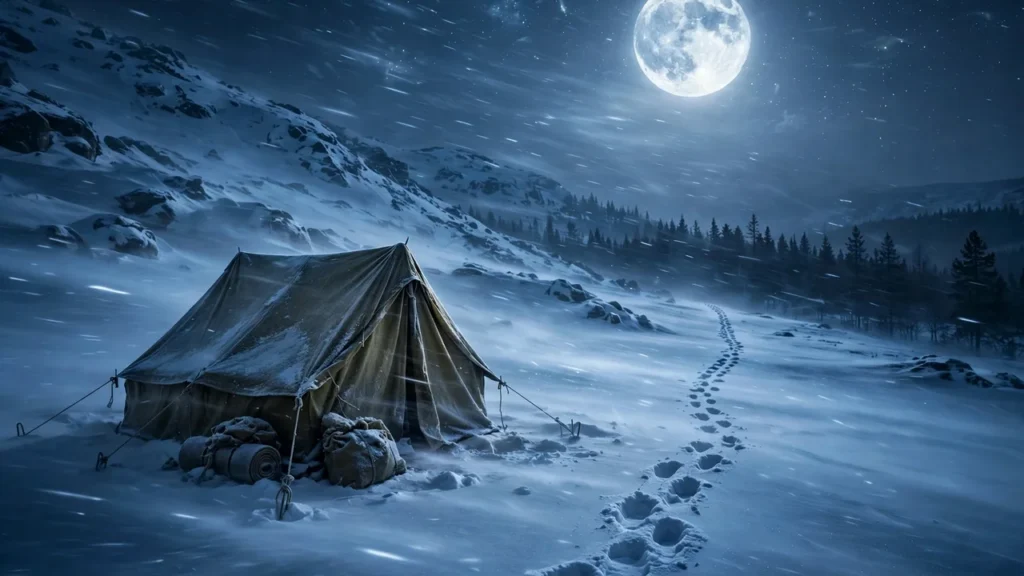
In the last days of January 1959, nine young ski-hikers from the Ural Polytechnic Institute set out into the northern Ural Mountains on an expedition that was supposed to be the making of them. They were fit, trained and experienced — most of them students or recent graduates in their early twenties, led by 23-year-old Igor Dyatlov, after whom the whole tragedy would come to be named. Their route would take them through some of the most remote winter wilderness in the Soviet Union.
Jump to section
On the night of 1–2 February, camped on the bare eastern slope of a mountain called Kholat Syakhl — a name often translated as “Dead Mountain” — something happened that has never been fully explained. The nine hikers cut their way out of their own tent from the inside and walked away from it into a night of deep cold and high wind, most of them without boots, coats or proper clothing. Not one of them survived. More than sixty years later, people are still arguing about why.
Watch the full report:
The last camp
The group’s diaries and cameras, recovered later, show a cheerful, confident party in the days before the end. On 1 February they climbed the slope of Kholat Syakhl and pitched their large tent on the open mountainside, digging it into the snow — a decision that would matter enormously to later investigators. What happened in the hours after that is reconstruction, not record. There is no witness, and there never would be.
When a search party finally reached the site on 26 February — sent out after the group failed to return and report in — they found the tent half-collapsed under snow and cut open from the inside, in several places. Inside it, in reasonable order, were the hikers’ boots, jackets, food and equipment. Whatever had driven nine experienced people out of their shelter had done so so suddenly that they had sliced through the canvas rather than use the entrance, and had left behind almost everything that could have kept them alive.
What the searchers found
Footprints led away down the slope toward the treeline, and the searchers followed them into one of the bleakest sequences in the history of mountaineering. Near a large cedar tree, about a kilometre and a half from the tent, they found the bodies of Yuri Doroshenko and Yuri Krivonischenko beside the remains of a small fire. Both men were in their underwear. Three more bodies — Igor Dyatlov, Zinaida Kolmogorova and Rustem Slobodin — were found between the cedar and the tent, as if they had died trying to climb back to it. The autopsies concluded that these hikers had died of hypothermia, though Slobodin had a fractured skull and one of the cedar pair had burns.
The last four took two more months to find. In May, searchers dug into a snow-filled ravine beyond the cedar and found Lyudmila Dubinina, Semyon Zolotaryov, Alexander Kolevatov and Nikolai Thibeaux-Brignolle under some four metres of snow. And here the story changed character completely. These were not simple deaths from cold. Thibeaux-Brignolle’s skull was severely fractured. Dubinina and Zolotaryov had multiple broken ribs — chest injuries of enormous force. The forensic examiner, Boris Vozrozhdenniy, recorded something that has haunted the case ever since: injuries comparable, he said, to those from a car crash, yet with no matching external wounds — and a force, he concluded, that no human attacker could have delivered. Dubinina’s tongue and eyes were missing, a detail that later fed decades of lurid speculation, though investigators have long noted she lay for weeks in meltwater under the snow, which accounts for the soft-tissue loss without any attacker at all.
One more strange detail entered the file: a radiological test found traces of elevated radiation on the clothing of two of the hikers. It sounds sinister, and in retellings it often is. The more measured reading is that one of the group, Krivonischenko, worked at the Mayak nuclear facility near Kyshtym — a plausible, mundane source of contamination on his clothes. On 28 May 1959 the Soviet investigation closed the case with a phrase that satisfied nobody: the hikers had died because of “a compelling natural force”.
The avalanche answer — and the arguments that remain
The theories since have filled books: a military weapons test, an attack by local Mansi hunters, infrasound panicking the group, a UFO. Most have collapsed under scrutiny — there was no evidence of any other people at the scene, for instance, beyond the nine sets of footprints. But for decades the obvious candidate, an avalanche, had a problem: the slope seemed too gentle, and no avalanche debris was recorded in 1959.
In July 2020, Russia’s Prosecutor General’s Office announced the conclusion of a fresh review: a slab avalanche. Snow piled above the tent platform the hikers had cut into the slope, it concluded, had shifted in the night — injuring some of the group and convincing them a far bigger slide was coming. They fled to the trees in near-zero visibility, and could not find their way back to the tent in the blizzard; the ravine four, sheltering in a den dug into the snow, were crushed when its roof collapsed. In 2021, two engineers, Johan Gaume and Alexander Puzrin, published peer-reviewed modelling supporting exactly that: a small, delayed slab release, on that gentle slope, could break ribs through the hikers’ bedding and gear without marking their skin — answering the case’s most famous forensic puzzle.
It is now the explanation most mainstream researchers accept. And yet the families of the nine have never fully accepted it, and the Dyatlov Foundation continues to dispute it. The avalanche model rests on reconstruction and mathematics, not on anything anyone saw; it does not, by itself, explain every oddity in the file, and the original investigation was, by any standard, incomplete. The case is, officially, solved. In the public mind it remains what it has been since 1959: nine young people, a cut tent, and a mountain that has never told the whole truth.
 Next article The Toxic Lady: Gloria Ramirez and the ER Mystery
Storyline UK is an independent entertainment publication. Film, programme and platform names belong to their respective owners; rumours are labelled as rumours.